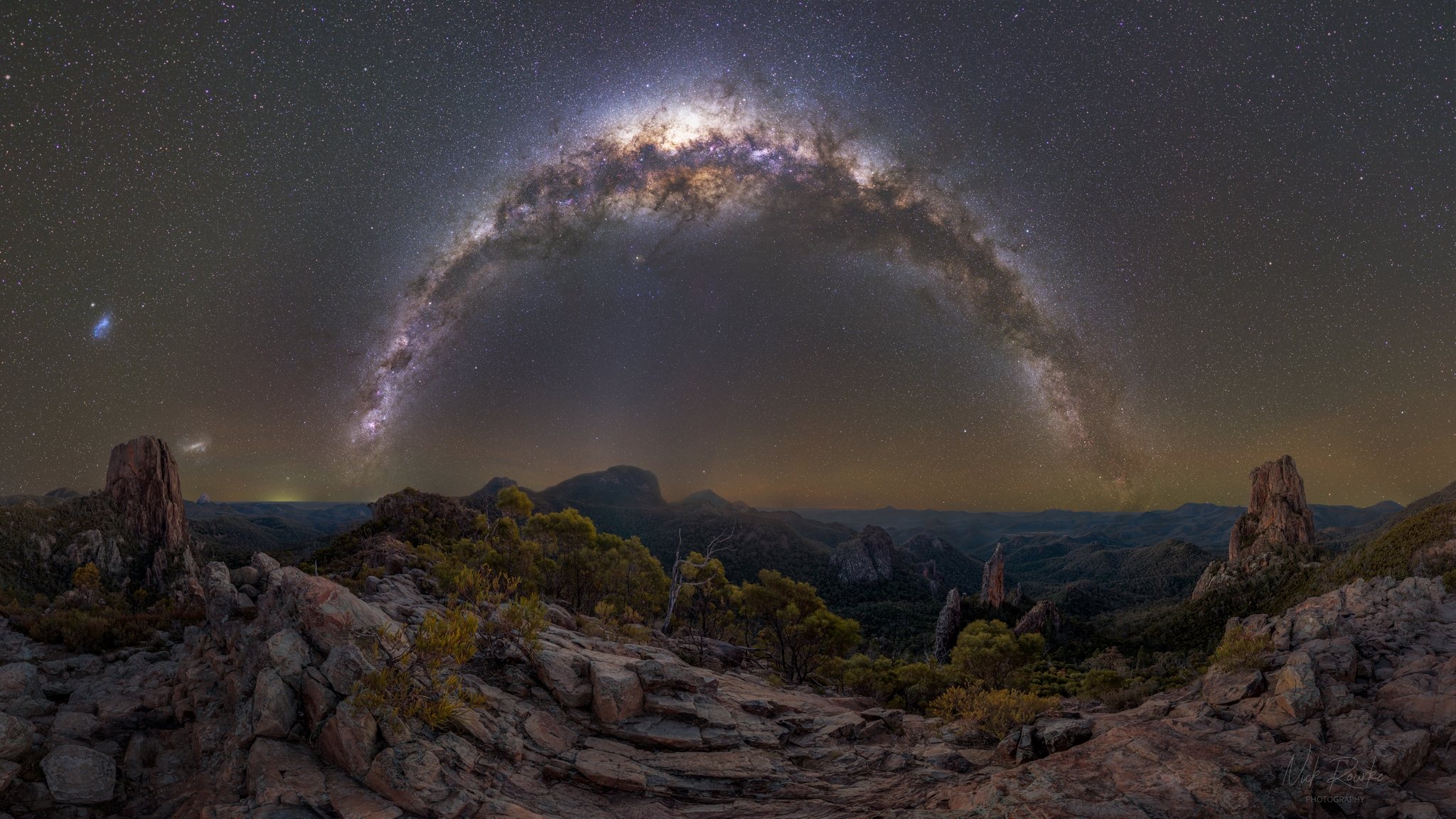

Autumn
May 2027
Times are computed for Coonabarabran / Siding Spring Observatory (SSO), latitude 31.27 south, longitude 149.06 east. Timezone Australia/Sydney. Early night means sunset until four hours after sunset. That is the window most guided night tours actually use.
Moon
Full Moon 20 May.
New Moon 6 May.
Dark nights 24 April to 9 May, then 23 May to 8 June.
- 24 April to 9 May
- 23 May to 8 June
Mid Month Sky Snapshot
Sunset, twilight and the Moon on the 15th, from Siding Spring Observatory (SSO).
- Sunset
- 5:16 pm
- Civil twilight
- 5:42 pm
- Astronomical twilight
- 6:40 pm
- Moon on the 15th
- Waxing Gibbous, 73% lit
- Moonrise
- 1:54 pm
- Moonset
- 1:13 am
Early night planets
Only planets that stand at least about 10 degrees above the horizon at some point between sunset and four hours after sunset. Morning-only planets are not listed.
Mars. North-east after sunset, north-west later in the evening.
Jupiter. Bright in the north after sunset, north-west later.
Worth looking at
Short list for the same early-night window. Objects operators actually point at, not a catalogue dump.
1. Milky Way / Celestial Emu
East later in the evening.
Naked eye. Best on Dark Nights.
2. Southern Cross and Pointers
South-east through the early night.
Naked eye.
3. Orion Nebula
West after sunset.
Binoculars or a small telescope help.
4. Omega Centauri
South-east through the early night.
A glow to the naked eye. Binoculars help.
5. Carina and Eta Carinae
South through the early night.
Naked eye. Binoculars help with the nebula.
6. Jewel Box
South-east through the early night.
Binoculars or a small telescope help.
This page is a sky clock. Pick your time to visit. We wish you clear skies. No guarantees with the weather.
Figures are for the 15th of the month.